

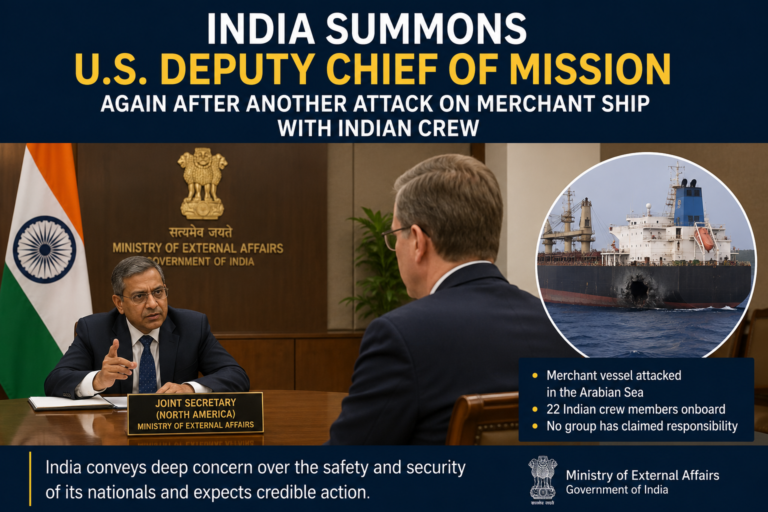
India Raises Concerns Over Maritime Security
India has once again summoned the U.S. Deputy Chief of Mission following another reported attack on a merchant vessel carrying Indian crew members in a strategically important maritime region. The move reflects New Delhi’s growing concern over the safety of Indian nationals working aboard commercial ships and the broader security challenges facing international shipping routes.
The latest incident has intensified discussions about maritime security, particularly in waters that have witnessed rising tensions, attacks on commercial vessels, and disruptions to global trade. India, which has one of the world’s largest pools of merchant navy personnel, has emphasized that the protection of its citizens remains a top priority.
Diplomatic Response From New Delhi
According to reports, Indian officials conveyed their concerns during a formal diplomatic meeting with the U.S. representative. The discussions reportedly focused on the recurring threats to merchant ships operating in conflict-prone regions and the need for stronger international efforts to ensure safe passage for civilian vessels.
India has consistently advocated for freedom of navigation and adherence to international maritime law. By summoning the U.S. Deputy Chief of Mission, New Delhi signaled the seriousness with which it views attacks that could endanger Indian sailors and disrupt international commerce.
Officials stressed that the safety and security of Indian crew members working on global shipping routes must not be compromised. The government is also believed to be closely monitoring developments and maintaining communication with relevant international stakeholders.
Growing Risks to Global Shipping
The latest attack highlights the increasing risks faced by merchant vessels operating in sensitive maritime corridors. These routes are vital for the movement of energy supplies, raw materials, and consumer goods across the world.
Any disruption in these waterways can have far-reaching consequences, including higher transportation costs, delays in supply chains, and increased insurance premiums for shipping companies. For countries heavily dependent on maritime trade, maintaining stability in these regions is of strategic importance.
Industry experts have warned that repeated attacks on commercial ships could undermine confidence in international shipping and create long-term challenges for global trade networks.
Impact on Indian Seafarers
India is among the leading suppliers of skilled maritime professionals to the global shipping industry. Thousands of Indian sailors serve on commercial vessels operating across international waters.
As attacks on merchant ships become more frequent, concerns about the welfare of Indian crew members have grown. Families of seafarers often face uncertainty when vessels operate in high-risk areas, making government intervention and diplomatic engagement essential.
The Indian government has repeatedly stated that it remains committed to safeguarding its citizens abroad and ensuring that shipping companies follow appropriate safety protocols.
International Cooperation Needed
The incident underscores the need for stronger international cooperation to address maritime security threats. Experts believe that coordinated naval patrols, intelligence sharing, and diplomatic engagement among major powers can help reduce risks to commercial shipping.
With global trade heavily dependent on secure sea routes, protecting merchant vessels has become a shared responsibility for the international community. Continued collaboration between governments, naval forces, and shipping operators will be crucial in preventing future incidents and maintaining stability in key maritime regions.
Conclusion
India’s decision to summon the U.S. Deputy Chief of Mission once again demonstrates the government’s determination to protect Indian nationals and seek accountability in matters affecting maritime security. As concerns over attacks on commercial vessels continue to grow, the incident serves as a reminder of the challenges facing global shipping and the importance of collective international action to ensure safe and secure seas.
For India, the safety of its seafarers remains a critical priority, and developments in maritime security are likely to remain high on the country’s diplomatic agenda in the coming months.